As wildfires blackened more than 1 million acres of the West last week, the debate over grazing on public land took on greater urgency and meaning.
It also provided several faces to the debate. Meet Jeanette Yturriondobeitia. She and her husband, Richard, have a ranch in southeastern Oregon, near the town of Basque, population 10.
They own the 12-Mile Ranch, which has borne much of the brunt of the 512,000-acre Long Draw wildfire -- the largest in recent Oregon history -- that roared across the region last week. They have lost 130 cattle and ranch structures -- and they almost lost their house.
"We came back from moving cattle in the middle of the night and found seven pumper trucks lined up defending our haystack and house," she told Capital Press reporter Dan Wheat.
With that much land -- most of it used for grazing -- blackened, she wonders how they'll get through the rest of the year.
"Every bit of our winter range and what's left of our summer range is burned," she said.
The couple is a founding member of the Trout Creek Mountain Working Group, which formed in the 1980s and included other ranchers, state and federal agencies and several environmental groups. Together, they agreed to reduce grazing on federal allotments to allow fish and wildlife habitat to return to health.
The area had been overgrazed, but in the intervening 30 years the wildlife habitat has returned to health and even the population of rare Lahontan cutthroat trout has more than doubled, to 24,000.
In light of their success they have been talking with the U.S. Bureau of Land Management, which oversees the federal land in the area, about increasing their grazing. More grazing would not only allow the them and their neighbors to run more cattle, it would maintain the habitat and, just as importantly, reduce the amount of grass that fuels wildfires.
Rangeland experts say properly managed grazing benefits the land and habitat. State and federal land managers agree, but are constantly harassed by some environmental groups, which cling to the notion that any grazing only spreads weeds and hurts wildlife habitat. They say cheatgrass, which can be spread by livestock, displaces native grasses that naturally resist fire.
For that and other reasons, they oppose virtually any grazing. Their goal is to convince the government to buy out grazing allotments across the West.
The problem for the environmental groups is that a lack of grazing could be worse for wildlife than properly managed grazing, just as no logging can be worse for forest ecology than properly managed logging.
As was proved by the Trout Creek group in Oregon and other similar groups across the West, wildlife habitat, streams and fish populations do thrive alongside grazing.
The sage grouse is of particular concern to all Westerners, particularly those who ranch. The bird, which the U.S. Fish and Wildlife Service says warrants protection under the Endangered Species Act, lives in 11 Western states and two Canadian provinces. As a "candidate" species for federal protection, it poses a threat to grazing because it lives in sage brush.
Agencies such as the Fish and Wildlife Service, the Natural Resources Conservation Service and the BLM have formed initiatives and working groups with ranchers to make sure the grouse populations remain healthy. They know that properly managed grazing will benefit the grouse and its habitat.
Wildfires also devastate wildlife habitat. Because cattle and sheep eat the grasses that fuel wildfires, more grazing could have reduced the severity of the blazes that scorched vast swaths of prime sage grouse habitat last week in Oregon, southern Idaho and elsewhere.
Meet Jared Brackett. He is the Idaho Cattle Association's vice president and ranches near Castleford, Idaho, where about 219,000 acres burned in the Kinyon Road fire.
He told Capital Press reporter Sean Ellis he is "extremely upset, disappointed and frustrated" that extra fuel -- grass that cattle grazing could have reduced -- was allowed to remain in the Jarbidge Resource Management Area, part of which the massive fire blackened.
"When you're only utilizing 5 to 10 percent of the resource, this is what happens," he said. "We're trying to help this bird out but they keep saying grazing is a threat to it. Well, fire is a greater threat."
He is correct.
Resource and rangeland managers know that cattle and wildlife can get along. They also know that ranchers are willing participants in efforts to protect and improve habitat and reduce wildfire dangers.
But the extreme environmentalists and their lawyers disagree. They want grazing stopped, no matter that it helps the environment and wildlife such as the sage grouse. As long as they can use the deeply flawed Endangered Species Act to stop grazing, they'll do it.
Maybe those environmental groups should think about filing another lawsuit. Maybe they should sue themselves for damaging the sage grouse's habitat by opposing more grazing.
Just a thought.
Capital Press
Thursday, July 19, 2012


Tuesday, July 17, 2012
Ben Nelson Goes Cow (Fees) Tipping
When outgoing Sen. Ben Nelson (D-Neb.) announced last month that he was pushing to reduce America's national deficit by reducing "welfare ranching" in America's heartland, so quiet was the political response in Washington that you could practically hear the crickets chirping along the Potomac. Undaunted, Sen. Nelson last Wednesday went one step further, announcing that he has introduced an eminently level-headed "Fair Grazing Fee" bill, designed to require the various agencies of the executive branch to charge market-level grazing fees for private ranchers who are running livestock on public land.
More crickets in Washington. But not on the ranches and farms of the nation's vast ranch lands. And certainly not in Nebraska. There, Sen. Nelson's new initiative is a very big deal for many different reasons. After all, it's not every day when an elected official, in the selfless pursuit of a common good, bucks up against the power of entrenched special interests and ... wait, wait, what's that? Sen. Nelson pitched his plan not just out of pure deficit-minded selflessness but because Republican nominee Deb Fischer, running this fall for the seat he is vacating, is herself a current beneficiary of "welfare ranching?"
Here's how the Omaha World-HeraldLeader put it last month: "The family of Republican Senate nominee Deb Fischer leases 11,724 acres of federal land in north-central Nebraska for about $4,700 for seven months -- by some estimates about $110,000 less than the market rate for leasing private land in Cherry County." Combine such a sweetheart deal with a GOP candidate whose campaign so far has focused upon deficit reduction and wasteful Washington spending and, presto! The Democrats have themselves a campaign theme with some measure of traction.
Sen. Nelson puts it another way. It's not a story about Washington picking on the ranching industry, you see; it's about inequality within that industry itself. Sen. Nelson says he isn't just sticking up for the hundreds of millions of Americans who would like to see their public land leased at market rates. He says he is also sticking up for the vast majority of ranchers who for one reason or another do not receive the benefit of federally subsidized ranching fees. Last week, the senator explained it this way to local journalists:
What do Fischer and her fellow Republicans think of Sen. Nelson's bright idea? I'll let the Lincoln Journal Star pick up the story from here:
Just ask the folks at the Center for Biological Diversity, a group dedicated (among other things) to the conservation of public lands. The Center's Public Land Campaigns Director, Taylor McKinnon, quickly praised the Nelson plan. "The grazing subsidy is America's upside-down public-lands policy," McKinnon told me last Friday. "Each year it costs the public hundreds of millions of dollars while enabling public-lands grazing that erodes soil and destroys wildlife habitat. Reform makes perfect economic and environmental sense. It's long overdue."
Overdue -- and clearly not a priority so far for the Obama Administration, which has stubbornly refused to expend any political capital on this issue. Here's what McKinnon had to say about the executive branch's contemporary approach to the problem of "welfare ranching" and its insidious subsidization:
link
More crickets in Washington. But not on the ranches and farms of the nation's vast ranch lands. And certainly not in Nebraska. There, Sen. Nelson's new initiative is a very big deal for many different reasons. After all, it's not every day when an elected official, in the selfless pursuit of a common good, bucks up against the power of entrenched special interests and ... wait, wait, what's that? Sen. Nelson pitched his plan not just out of pure deficit-minded selflessness but because Republican nominee Deb Fischer, running this fall for the seat he is vacating, is herself a current beneficiary of "welfare ranching?"
Here's how the Omaha World-Herald
Sen. Nelson puts it another way. It's not a story about Washington picking on the ranching industry, you see; it's about inequality within that industry itself. Sen. Nelson says he isn't just sticking up for the hundreds of millions of Americans who would like to see their public land leased at market rates. He says he is also sticking up for the vast majority of ranchers who for one reason or another do not receive the benefit of federally subsidized ranching fees. Last week, the senator explained it this way to local journalists:
I have offered an Amendment to help pay for the Jobs Bill, an Amendment that will bring fairness to America's ranchers and all taxpayers. My Amendment will require the US Forest Service and the Federal Bureau of Land Management to charge market value to those who graze livestock on public lands. As you probably know, an elite group of ranchers, I call them the 'two-percenters,' they currently receive about $140 million a year in federal subsidies to graze livestock on publicly-owned land. In these hard economic times, taxpayers shouldn't be padding the pocketbooks of the elite two-percent who get a special deal that 98% of ranchers don't.And here's more from his website:
... The State of Nebraska charges over $20 dollars a head of calf to graze on state land. Why should the federal government charge $1.35?... Let's go through some numbers. All the grazing fees on federal lands add up to about $21 million dollars. But it costs the federal government $140-some million dollars to take care of those lands. In other words, there is a shortfall of $120 million dollars coming from two percent of ranchers. If I'm one of the 98 percent, I'm going to say 'that's not fair." That's why this is a matter of tax fairness.In this day and age, who could be against "tax fairness"? Certainly not Bob Kerrey, the former Nebraska senator and governor who is running (against Fischer) for Nelson's soon-to-be-empty seat. "I believe the free market should set the prices for grazing on federal land," Kerrey said last month in a press release after Nelson first announced his pitch. "Giving generous subsidies to a small number of ranchers isn't fair to the vast majority of ranchers who don't have this grazing privilege. Further, it isn't fair to the taxpayers who are subsidizing this form of welfare.
What do Fischer and her fellow Republicans think of Sen. Nelson's bright idea? I'll let the Lincoln Journal Star pick up the story from here:
The Nebraska Democratic Party launched a new TV ad campaign Monday accusing Republican Senate nominee Deb Fischer of accepting millions of dollars in "taxpayer subsidies";at the same time, she calls for reduced federal spending. "Think you know Deb Fischer?" the attack ad asks. "Well, behind her rhetoric is a lot of bull. Tell welfare rancher Deb Fischer to cut wasteful spending, not profit from it."An act of desperation, perhaps. But that doesn't make Sen. Nelson's plan bad national policy. Indeed, regardless of its local-political overtones, and regardless of the senator's motives in promoting it, making federal grazing fees at least match the market rate is sound and equitable policy that deserves serious consideration on Capitol Hill. The fact is, for the past 75 years, "welfare ranching" has eroded public resources for the benefit of an industry that gladly accepts the federal dole at the same time it is blasting Washington for its largesse.
Democrats clearly have decided Fischer's participation in a federal livestock grazing rights program that benefits her own family ranch may be a chink in her conservative, cost-cutting armor they might be able to exploit. Sen. Ben Nelson and Bob Kerrey, her Democratic Senate opponent, already have questioned Fischer's acceptance of what they describe as federal subsidies that result from charging below-market fees for cattle grazing rights on U.S. Forest Service land.
"Ranchers are required to pay for additional maintenance costs and abide by strict federal regulations in exchange for leasing the land," Fischer campaign spokesman Daniel Keylin said. Republican Sen. Mike Johanns, a former U.S. secretary of agriculture, already has said it was misleading to describe the program as a subsidy, Keylin pointed out. Johanns said the lease requires substantial activity by a rancher in return for limited use of the land. Republican state Chairman Mark Fahleson branded the ads an act of desperation.
Just ask the folks at the Center for Biological Diversity, a group dedicated (among other things) to the conservation of public lands. The Center's Public Land Campaigns Director, Taylor McKinnon, quickly praised the Nelson plan. "The grazing subsidy is America's upside-down public-lands policy," McKinnon told me last Friday. "Each year it costs the public hundreds of millions of dollars while enabling public-lands grazing that erodes soil and destroys wildlife habitat. Reform makes perfect economic and environmental sense. It's long overdue."
Overdue -- and clearly not a priority so far for the Obama Administration, which has stubbornly refused to expend any political capital on this issue. Here's what McKinnon had to say about the executive branch's contemporary approach to the problem of "welfare ranching" and its insidious subsidization:
We've both petitioned and sued the Obama Administration seeking a significantly fairer fee, but they resist change. So after years of their skulking and cowering, it's refreshing to see someone with guts enough to tell the truth and demand a discussion about real reform."Real reform" can come from many different places and for many different reasons. Maybe Sen Nelson is, as McKinnon suggests, just being gutsy for pitching his plan now. Maybe he is, as Nebraska's Republicans contend, just being ballsy on his way out. Either way, and whomever wins or loses the Senate race for his seat in Nebraska, fair grazing fees and the end of "welfare ranching" is a good idea whose time, finally, has come. As the senator himself put it, "$1.35 per cow is too darn low." Darn right it is.
link
Wednesday, July 11, 2012
Western Watersheds Project Acts: Grand Staircase Escalante National Monumen
Western Watersheds Project Acts: Grand Staircase Escalante National Monument
~ Jonathan Ratner , Wyoming Director

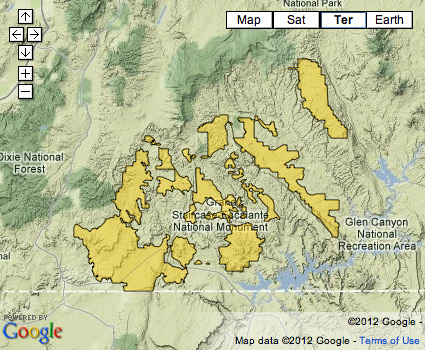
Last week, Western Watersheds Project filed suit against the Bureau of Land Management for failing to act to protect the precious resources of the Grand Staircase - Escalante National Monument (GSENM) from the damages of livestock grazing.
The monument was established by President Clinton in 1996 on 1.9 million acres of BLM land containing stunning geologic formations and unique ecosystems. The proclamation required that the new Monument be managed beyond the usual 'multiple use' approach taken by the BLM.
Its mandate:
However, 16 years after the Monument was established, the BLM has not even gotten around to put in place a management framework to deal with livestock grazing in light of the purposes for which the Monument was established. Instead of managing the GSENM better than the rest of BLM lands, befitting a National Monument, the BLM failed to even comply with its own national grazing regulations.
Case in point: In 2006, the BLM conducted Rangeland Health Assessments across the Monument and found 21 allotments or more than half the Monument failing Rangeland Health Standards due to livestock. Rather than address these failings, BLM buried the assessments. When word leaked out, BLM was forced to provide all 21 determinations to the public. However, the BLM is also required under its own regulations to take actions to correct Rangeland Health failures before the start of the next grazing season, but in this case, 6 years have ticked by and the BLM has not worked to correct the problems and reverse the degradation that is occurring.
On July 6th, with the representation of Meyer Glitzenstein & Crystal, WWP filed litigation in Washington D.C. to force the agency to implement the actions that the BLM itself determined were necessary to stop grazing damage to this national treasure. The land shouldn't have to wait any longer.
Many thanks to Meyer Glitzenstein & Crystal, Dr. John Carter, Dr. Jim Caitlin of Wild Utah Project, and WWP's Laura Welp for helping to bring these problems to light!
~ Jonathan Ratner , Wyoming Director
Last week, Western Watersheds Project filed suit against the Bureau of Land Management for failing to act to protect the precious resources of the Grand Staircase - Escalante National Monument (GSENM) from the damages of livestock grazing.
The monument was established by President Clinton in 1996 on 1.9 million acres of BLM land containing stunning geologic formations and unique ecosystems. The proclamation required that the new Monument be managed beyond the usual 'multiple use' approach taken by the BLM.
Its mandate:
First and foremost, the Monument will remain protected in its primitive, frontier state. The BLM will safeguard the remote and undeveloped character of the Monument, which is essential to the protection of the scientific and historic resources. Second, the Monument will provide opportunities for the study of scientific and historic resources.
However, 16 years after the Monument was established, the BLM has not even gotten around to put in place a management framework to deal with livestock grazing in light of the purposes for which the Monument was established. Instead of managing the GSENM better than the rest of BLM lands, befitting a National Monument, the BLM failed to even comply with its own national grazing regulations.
Case in point: In 2006, the BLM conducted Rangeland Health Assessments across the Monument and found 21 allotments or more than half the Monument failing Rangeland Health Standards due to livestock. Rather than address these failings, BLM buried the assessments. When word leaked out, BLM was forced to provide all 21 determinations to the public. However, the BLM is also required under its own regulations to take actions to correct Rangeland Health failures before the start of the next grazing season, but in this case, 6 years have ticked by and the BLM has not worked to correct the problems and reverse the degradation that is occurring.
On July 6th, with the representation of Meyer Glitzenstein & Crystal, WWP filed litigation in Washington D.C. to force the agency to implement the actions that the BLM itself determined were necessary to stop grazing damage to this national treasure. The land shouldn't have to wait any longer.
Many thanks to Meyer Glitzenstein & Crystal, Dr. John Carter, Dr. Jim Caitlin of Wild Utah Project, and WWP's Laura Welp for helping to bring these problems to light!

Thursday, June 28, 2012
Ranchers who say they helped restore lands now want better access for their cattle herds
by DAN WHEAT
Capital Press
WHITEHORSE RANCH, Ore. -- Arid vistas of sagebrush and grasses. Green fields in valleys.
The high desert country of southeastern Oregon has healed. Where thousands of cattle once worked their way across the landscape, only a fraction of that graze today, allowing the plants, streams and fish to recover.
Willows now flourish along stream banks, water quality and riparian conditions have improved, and rare lahontan cutthroat trout in creeks now number 24,000 compared with 10,000 in 1989, said Garth Ross, a wildlife biologist for the Bureau of Land Management in Malheur County, stationed in Vale, Ore.
A 20-year-old agreement reached by seven ranchers, state and federal agencies and environmental groups has restored fish, wildlife and habitat while preserving grazing rights for cattle.
Ranchers, who say they are grateful they're even still here, add that they've kept up their end of the bargain by drastically reducing grazing to allow the land to recuperate. Now they wonder whether they'll be able to regain at least some rights to more grazing in return.
Richard Yturriondobeitia, owner of 12-Mile Ranch, is an original member of the Trout Creek Mountain Working Group, which negotiated the agreement.
"Our management practices are better and we had our eyes opened to things we were doing wrong, but there is no progress," he said. "The agreement didn't turn out to be exactly what we thought it would be. We didn't make the BLM establish certain goals so we weren't able to get grazing we thought we would."
The region's sprawling ranches, incorporating both private and public land, are shadows of their former selves in numbers of cattle and cowboys. They are not alone.
Other cattle ranchers throughout the West want more grazing but feel outnumbered by environmentalists, who challenge grazing on publicly owned land because it can threaten species that are or may be listed as endangered or threatened under federal law.
How it started
The threat of environmental lawsuits aiming to stop decades of overgrazing and degradation of streams and fish brought Doc and Connie Hatfield, ranchers from Brothers, Ore., to spearhead the working group in the late 1980s. The Hatfields, best known as founders of the Country Natural Beef cooperative, had been involved in an agreement in the Prineville, Ore., BLM district. BLM officials invited them to speak with Trout Creek Mountain ranchers.
Their intent, according to their own booklet on the history of the working group, was to save both the environment and the region's ranches.
Since the 1960s, ranchers had tried fencing and keeping cattle away from creeks in the heat of summer but degradation continued, the Hatfields wrote in their "History of the Trout Creek Mountain Working Group."
The group formed in 1988. The seven ranches and representatives of the Oregon Cattlemen's Association, BLM, Oregon Department of Fish and Wildlife, U.S. Fish and Wildlife Service, the Oregon Environmental Council, Oregon Trout and the Izaak Walton League reached the final accord in 1992.
High-mountain grazing that occurred all summer was reduced to mid-May to mid-July to give grass time to regrow before fall and prevent grazing of willow and vegetation along streams. The shortened high-country grazing is allowed for two years in a given area and followed by two years of no grazing rest.
The ranches voluntarily stopped high-country grazing for three years before the agreement was completed.
Fewer cattle
Prior to the agreement, the area had close to 30,000 AUMs (animal unit months). An AUM is one month's grazing for one cow and one calf. Now grazing is reduced 6,640 AUMs, the BLM's Ross said. The total number of cattle is probably down 75 to 80 percent, he said.
Of the ranches affected by the agreement the Whitehorse Ranch was hit the hardest, ranchers said. It went from 3,000 to 3,500 head of cattle down to 800, said David Herman, who bought the ranch in 2006.
But that doesn't necessarily mean less profitability, he said.
"It's hard to know. Profit isn't always more volume," he said. "It's keeping costs in line."
With high beef prices the ranches are doing relatively well and may for some time since the supply of beef likely will lag behind demand for the foreseeable future, Herman said. On the flip side are rising costs, including fuel.
Comparing profit now to 20 or 30 years ago is hard to do, said Yturriondobeitia, owner of 12-Mile Ranch, the closest ranch east of the Whitehorse. But the ranches have been impacted financially by cattle weighing less and poorer conception and weaning rates because of less summertime high-country grazing, he said.
The mid-May to mid-July high-country grazing is too early and doesn't fit the grass, he said. Grazing an area for two years then having two years of rest isn't needed; proper timing of grazing is, he said.
The ranchers thought they were making progress toward some changes in the last five years but a new BLM manager went "back to doing things by the book," Yturriondobeitia said. The BLM moves employees around so relations seldom get beyond getting to know them, he said.
Yturriondobeitia is of Basque descent and is 67 years old. His wife, Jeanette, is 66. They hope their son, Dan, 43, and daughter, Jaime, 40, will keep the ranch going.
"But if we can't have consistency and goals, why would the next generation even want to do it?" he asked.
What others say
Grazing of willow along streams is now down to 2 percent while 20 percent is allowed by the agreement, Herman said.
Fish, wildlife and habitat are better off but "where's the advocate, where's PETA (People for the Ethical Treatment of Animals) for the cows?" he asked.
Cattle are stressed because they are moved too early when they are lactating or just calved or on a certain calendar date when it may be too hot, Herman said.
He's trying to do his part, he said, in breeding cattle better suited for the desert that are 30 percent Angus, 20 percent Hereford, 20 percent Braford, 20 percent Beefmaster and 10 percent Chianina.
Gary and Marjorie Defenbaugh and their son, Ross, own the nearest ranch west of the Whitehorse. They also are original working group members but their land is in a different BLM district, where high-country grazing is allowed into mid-September.
The Defenbaughs are concerned about the Oregon Natural Desert Association, an environmental group, pushing to declare their BLM range land wilderness, ending all cattle grazing.
The BLM is scared of environmental groups but could do more seeding and brush control to manage lands for grazing, Marjorie Defenbaugh said.
Land near their house appeared overgrazed. There is overgrazing in spots on their private land because it's a dry year of lighter grass production, Marjorie said.
Steve and Amorita Maher own a ranch south of 12-Mile Ranch and east of Oregon Canyon Mountains. They are also original members of the working group, as were her parents. His father was cow boss of Whitehorse Ranch in the 1950s.
"To my knowledge no one ever signed anything. The BLM just gave us an ultimatum so we had to work things out with the environmentalists. Otherwise, we wouldn't be running cattle," Steve Maher said.
The first few years they didn't reduce their herd enough and overused the lowlands, Maher said.
Mid-May is too early to graze the high country because grass hasn't grown enough, he said. Mid-June to mid-August was allowed for awhile and worked well, he said.
He is working to get a U.S. Fish and Wildlife Service biological opinion changed to allow mid-June to mid-August high grazing and two years of grazing followed by one year of rest instead of the current two on and two off. Better high-country grazing is needed because most of the ranches don't have the lowland winter range that the Whitehorse has, he said.
Riparian areas are in excellent condition and BLM range conservationists work well with the ranches, Maher said.
"We've never had a lawsuit against us and we feel that's a positive thing," he said.
Part of a larger picture
While cattle ranchers in other parts of the West have ended up embroiled in lawsuits with environmentalists, the Trout Creek Mountain Working Group Agreement has been used by judges to toss out environmental challenges because of the environmental groups that signed on.
That's why the grazing rights of the agreement, Maher said, have been called the most secure grazing rights in the West.
Ken Bentz, a rancher near Crane, is the grandson of Paul Stewart, who owned Whitehorse Ranch from 1945 to 1961.
"Everyone always talks about compromise, but it was a little bit (of grazing rights) or nothing. There was no compromise," Bentz said of the agreement.
Ranchers throughout the West who depend on BLM grazing rights feel outnumbered and jeopardized by environmentalists pushing the BLM, he said.
"People think we have no right to be here even though we do. The person with the cow owns the grass and the government owns the land," Bentz said. "We were here long before the government showed up and said they own the land in the Taylor Grazing Act of 1934."
The act allowed the government to regulate grazing on federal land.
Rep. Greg Walden, who represents Eastern Oregon in the U.S. House of Representatives, co-sponsored a bill, HR4234, authorizing the BLM and U.S. Forest Service to award grazing permits for 20 years instead of 10. The idea is to give ranchers more certainty to invest in their ranches. The bill passed the House June 19 and went to the Senate.
It's really in the public's best interest, Herman said, to maintain cattle grazing.
"The public spends money to fight fires. The public wants beef to eat," Herman said. "People think the rancher is getting a sweet deal on grazing, but we pay for those permits. Everyone agrees grazing renews the grass. Without it, the grass stands dead and is fuel for fires."
Capital Press
WHITEHORSE RANCH, Ore. -- Arid vistas of sagebrush and grasses. Green fields in valleys.
The high desert country of southeastern Oregon has healed. Where thousands of cattle once worked their way across the landscape, only a fraction of that graze today, allowing the plants, streams and fish to recover.
Willows now flourish along stream banks, water quality and riparian conditions have improved, and rare lahontan cutthroat trout in creeks now number 24,000 compared with 10,000 in 1989, said Garth Ross, a wildlife biologist for the Bureau of Land Management in Malheur County, stationed in Vale, Ore.
A 20-year-old agreement reached by seven ranchers, state and federal agencies and environmental groups has restored fish, wildlife and habitat while preserving grazing rights for cattle.
Ranchers, who say they are grateful they're even still here, add that they've kept up their end of the bargain by drastically reducing grazing to allow the land to recuperate. Now they wonder whether they'll be able to regain at least some rights to more grazing in return.
Richard Yturriondobeitia, owner of 12-Mile Ranch, is an original member of the Trout Creek Mountain Working Group, which negotiated the agreement.
"Our management practices are better and we had our eyes opened to things we were doing wrong, but there is no progress," he said. "The agreement didn't turn out to be exactly what we thought it would be. We didn't make the BLM establish certain goals so we weren't able to get grazing we thought we would."
The region's sprawling ranches, incorporating both private and public land, are shadows of their former selves in numbers of cattle and cowboys. They are not alone.
Other cattle ranchers throughout the West want more grazing but feel outnumbered by environmentalists, who challenge grazing on publicly owned land because it can threaten species that are or may be listed as endangered or threatened under federal law.
How it started
The threat of environmental lawsuits aiming to stop decades of overgrazing and degradation of streams and fish brought Doc and Connie Hatfield, ranchers from Brothers, Ore., to spearhead the working group in the late 1980s. The Hatfields, best known as founders of the Country Natural Beef cooperative, had been involved in an agreement in the Prineville, Ore., BLM district. BLM officials invited them to speak with Trout Creek Mountain ranchers.
Their intent, according to their own booklet on the history of the working group, was to save both the environment and the region's ranches.
Since the 1960s, ranchers had tried fencing and keeping cattle away from creeks in the heat of summer but degradation continued, the Hatfields wrote in their "History of the Trout Creek Mountain Working Group."
The group formed in 1988. The seven ranches and representatives of the Oregon Cattlemen's Association, BLM, Oregon Department of Fish and Wildlife, U.S. Fish and Wildlife Service, the Oregon Environmental Council, Oregon Trout and the Izaak Walton League reached the final accord in 1992.
High-mountain grazing that occurred all summer was reduced to mid-May to mid-July to give grass time to regrow before fall and prevent grazing of willow and vegetation along streams. The shortened high-country grazing is allowed for two years in a given area and followed by two years of no grazing rest.
The ranches voluntarily stopped high-country grazing for three years before the agreement was completed.
Fewer cattle
Prior to the agreement, the area had close to 30,000 AUMs (animal unit months). An AUM is one month's grazing for one cow and one calf. Now grazing is reduced 6,640 AUMs, the BLM's Ross said. The total number of cattle is probably down 75 to 80 percent, he said.
Of the ranches affected by the agreement the Whitehorse Ranch was hit the hardest, ranchers said. It went from 3,000 to 3,500 head of cattle down to 800, said David Herman, who bought the ranch in 2006.
But that doesn't necessarily mean less profitability, he said.
"It's hard to know. Profit isn't always more volume," he said. "It's keeping costs in line."
With high beef prices the ranches are doing relatively well and may for some time since the supply of beef likely will lag behind demand for the foreseeable future, Herman said. On the flip side are rising costs, including fuel.
Comparing profit now to 20 or 30 years ago is hard to do, said Yturriondobeitia, owner of 12-Mile Ranch, the closest ranch east of the Whitehorse. But the ranches have been impacted financially by cattle weighing less and poorer conception and weaning rates because of less summertime high-country grazing, he said.
The mid-May to mid-July high-country grazing is too early and doesn't fit the grass, he said. Grazing an area for two years then having two years of rest isn't needed; proper timing of grazing is, he said.
The ranchers thought they were making progress toward some changes in the last five years but a new BLM manager went "back to doing things by the book," Yturriondobeitia said. The BLM moves employees around so relations seldom get beyond getting to know them, he said.
Yturriondobeitia is of Basque descent and is 67 years old. His wife, Jeanette, is 66. They hope their son, Dan, 43, and daughter, Jaime, 40, will keep the ranch going.
"But if we can't have consistency and goals, why would the next generation even want to do it?" he asked.
What others say
Grazing of willow along streams is now down to 2 percent while 20 percent is allowed by the agreement, Herman said.
Fish, wildlife and habitat are better off but "where's the advocate, where's PETA (People for the Ethical Treatment of Animals) for the cows?" he asked.
Cattle are stressed because they are moved too early when they are lactating or just calved or on a certain calendar date when it may be too hot, Herman said.
He's trying to do his part, he said, in breeding cattle better suited for the desert that are 30 percent Angus, 20 percent Hereford, 20 percent Braford, 20 percent Beefmaster and 10 percent Chianina.
Gary and Marjorie Defenbaugh and their son, Ross, own the nearest ranch west of the Whitehorse. They also are original working group members but their land is in a different BLM district, where high-country grazing is allowed into mid-September.
The Defenbaughs are concerned about the Oregon Natural Desert Association, an environmental group, pushing to declare their BLM range land wilderness, ending all cattle grazing.
The BLM is scared of environmental groups but could do more seeding and brush control to manage lands for grazing, Marjorie Defenbaugh said.
Land near their house appeared overgrazed. There is overgrazing in spots on their private land because it's a dry year of lighter grass production, Marjorie said.
Steve and Amorita Maher own a ranch south of 12-Mile Ranch and east of Oregon Canyon Mountains. They are also original members of the working group, as were her parents. His father was cow boss of Whitehorse Ranch in the 1950s.
"To my knowledge no one ever signed anything. The BLM just gave us an ultimatum so we had to work things out with the environmentalists. Otherwise, we wouldn't be running cattle," Steve Maher said.
The first few years they didn't reduce their herd enough and overused the lowlands, Maher said.
Mid-May is too early to graze the high country because grass hasn't grown enough, he said. Mid-June to mid-August was allowed for awhile and worked well, he said.
He is working to get a U.S. Fish and Wildlife Service biological opinion changed to allow mid-June to mid-August high grazing and two years of grazing followed by one year of rest instead of the current two on and two off. Better high-country grazing is needed because most of the ranches don't have the lowland winter range that the Whitehorse has, he said.
Riparian areas are in excellent condition and BLM range conservationists work well with the ranches, Maher said.
"We've never had a lawsuit against us and we feel that's a positive thing," he said.
Part of a larger picture
While cattle ranchers in other parts of the West have ended up embroiled in lawsuits with environmentalists, the Trout Creek Mountain Working Group Agreement has been used by judges to toss out environmental challenges because of the environmental groups that signed on.
That's why the grazing rights of the agreement, Maher said, have been called the most secure grazing rights in the West.
Ken Bentz, a rancher near Crane, is the grandson of Paul Stewart, who owned Whitehorse Ranch from 1945 to 1961.
"Everyone always talks about compromise, but it was a little bit (of grazing rights) or nothing. There was no compromise," Bentz said of the agreement.
Ranchers throughout the West who depend on BLM grazing rights feel outnumbered and jeopardized by environmentalists pushing the BLM, he said.
"People think we have no right to be here even though we do. The person with the cow owns the grass and the government owns the land," Bentz said. "We were here long before the government showed up and said they own the land in the Taylor Grazing Act of 1934."
The act allowed the government to regulate grazing on federal land.
Rep. Greg Walden, who represents Eastern Oregon in the U.S. House of Representatives, co-sponsored a bill, HR4234, authorizing the BLM and U.S. Forest Service to award grazing permits for 20 years instead of 10. The idea is to give ranchers more certainty to invest in their ranches. The bill passed the House June 19 and went to the Senate.
It's really in the public's best interest, Herman said, to maintain cattle grazing.
"The public spends money to fight fires. The public wants beef to eat," Herman said. "People think the rancher is getting a sweet deal on grazing, but we pay for those permits. Everyone agrees grazing renews the grass. Without it, the grass stands dead and is fuel for fires."
Wednesday, June 27, 2012
Labrador's forest management plan would give Idaho control of some national forests
Labrador’s bill would give states control over large chunks of federal forests to raise money to pay for local roads and schools.
Idaho Republican Rep. Raul Labrador is looking past the November election with a bill that would give states opportunities to show they do a better job managing national forest lands.
Labrador knows his bill, which would establish pilot projects to turn over about 1 percent of Idaho’s 20 million acres of national forests to the state to manage, is not going to fly now. Not with a Democratic Senate — which has blocked similar plans in the past — and with a Democrat in the White House.
But Labrador is laying the groundwork with the Self-Sufficient Community Lands Act for a time when the GOP controls the Senate.
Campaigning in Idaho in February, GOP presidential candidate Mitt Romney expressed support for state management of federal lands. Romney’s proposal, which he said came after talking to Idaho Gov. Butch Otter, was offered as an alternative to Rick Santorum’s call to transfer ownership.
“It just gives every state the opportunity to manage their lands with local control, which is what we want,” Labrador said.
The plan has been a nonstarter for environmental groups, even those working in collaboration with Idaho counties and the timber industry. The groups want to keep federal lands managed by federal agencies.
States “would have a different mandate than managing our forests for the benefit of the American people,” said Brad Brooks, Wilderness Society deputy regional director.
IDAHO COUNTIES LOOKING FOR HELP
Labrador’s proposal comes out of a proposal by five rural Idaho counties struggling with some of the highest unemployment in the state. They are desperate because they stand to lose $31 million in federal assistance that has helped keep them afloat following the decline of their timber economies.
That money has come from the Secure Rural Schools and Community Self-Determination Act — better known as Craig-Wyden, after the two Northwest senators who championed it. The act replaces revenues from drastically dwindled timber sale receipts that once buoyed counties and school districts with large tracts of federal timberlands and little private land to generate property taxes.
JOBS, RURAL ECONOMIES
Deep federal budget cuts threaten the future of the Secure Rural Schools funds. The counties believe Labrador’s bill offers them a way to offset at least part of that lost funding. They hope it also would provide jobs and help to rebuild the timber industry and rural economies.
“I am excited to try something besides standing around with our hand out for a federal check,” said Skip Brandt, an Idaho County commissioner who also worked on the proposal.
MAXIMIZING STATE REVENUE
The bill applies not just to Idaho. Any state could set up a forest trust board to manage 200,000 acres or more of national forests. Federal environmental laws would still be in effect, but only as if the lands were state lands.
That would reduce the requirements for states to consult on projects under the Endangered Species Act and to assess them under the National Environmental Policy Act and the National Forest Planning and Management Act. State forestry departments, such as the Idaho Department of Lands, would manage the lands to maximize the long-term return for the counties after covering their costs.
One key savings to states: The Forest Service would still be responsible for fire protection — the biggest expense.
How much the pilot plan would return to the counties is part of the debate. The Idaho counties have predicted about $13 million annually, based on how much net income the state lands produce.
Since the counties came to the Idaho Land Board, the state has analyzed the 1 million acres adjacent to state lands from which the pilot lands might be chosen. Predicting with any precision the net income would be hard until specific forests and conditions are revealed, said David Groeschl, Idaho’s state forester.
He’d also need to know how many people he will have to hire to do the actual management. Timber markets have been soft since 2008, he said. His estimate ranges from $7 million to $12 million, depending on the market.
OTHER BENEFITS
Labrador sees more than just timber receipts benefiting the communities. He predicted jobs in timber mills, logging and other services.
But Chris Mehl of Headwaters Economics in Bozeman, Mont., said productivity gains in modern mills have reduced industry jobs.
Headwaters’ analysis suggests far less would be generated, especially with the current depressed timber markets.
“Even if the bill worked, the scale of created jobs will be small,” Mehl said. “The jobs will pay well because workers will have to be able to operate a variety of highly complicated equipment, but will be few in number compared to 30 years ago.”
He and environmentalists support more logging but seek more balanced development and federal land policy that also promotes fish and wildlife habitat restoration. Labrador’s bill promotes industrial forestry like states do on their land, Mehl said.
“What would be gained, or lost, in favoring the one industry over others and the repeal of the environmental safeguard laws?” Mehl asked.
Forest Service officials have cooperated with Labrador, but privately many in the agency resent the idea that somehow states can do better.
Groeschl said his Forest Service counterparts feel hamstrung by the very laws this bill would shield the states from.
“If you gave them the opportunity to manage those lands professionally, they could do a fine job,” he said.
Environmental groups also don’t like the makeup of the proposed trust board that would control the pilot project lands. It would have four members: a county commissioner, a timber industry representative, a rancher or miner and a recreation representative.
“There would be no incentive to collaborate with any conservation interest,” the Wilderness Society’s Brooks said.
But Gordon Cruickshank, a Valley County commissioner who helped develop the proposal, has been working with conservation groups to improve the health of the forests and the economy of their communities.
Labrador’s bill is designed to begin a national discussion that doesn’t have to focus on timber harvest, he said.
“It’s not about trees,” Cruickshank said. “It’s about opportunity.”
Rocky Barker: 377-6484
Link
Labrador knows his bill, which would establish pilot projects to turn over about 1 percent of Idaho’s 20 million acres of national forests to the state to manage, is not going to fly now. Not with a Democratic Senate — which has blocked similar plans in the past — and with a Democrat in the White House.
But Labrador is laying the groundwork with the Self-Sufficient Community Lands Act for a time when the GOP controls the Senate.
Campaigning in Idaho in February, GOP presidential candidate Mitt Romney expressed support for state management of federal lands. Romney’s proposal, which he said came after talking to Idaho Gov. Butch Otter, was offered as an alternative to Rick Santorum’s call to transfer ownership.
“It just gives every state the opportunity to manage their lands with local control, which is what we want,” Labrador said.
The plan has been a nonstarter for environmental groups, even those working in collaboration with Idaho counties and the timber industry. The groups want to keep federal lands managed by federal agencies.
States “would have a different mandate than managing our forests for the benefit of the American people,” said Brad Brooks, Wilderness Society deputy regional director.
IDAHO COUNTIES LOOKING FOR HELP
Labrador’s proposal comes out of a proposal by five rural Idaho counties struggling with some of the highest unemployment in the state. They are desperate because they stand to lose $31 million in federal assistance that has helped keep them afloat following the decline of their timber economies.
That money has come from the Secure Rural Schools and Community Self-Determination Act — better known as Craig-Wyden, after the two Northwest senators who championed it. The act replaces revenues from drastically dwindled timber sale receipts that once buoyed counties and school districts with large tracts of federal timberlands and little private land to generate property taxes.
JOBS, RURAL ECONOMIES
Deep federal budget cuts threaten the future of the Secure Rural Schools funds. The counties believe Labrador’s bill offers them a way to offset at least part of that lost funding. They hope it also would provide jobs and help to rebuild the timber industry and rural economies.
“I am excited to try something besides standing around with our hand out for a federal check,” said Skip Brandt, an Idaho County commissioner who also worked on the proposal.
MAXIMIZING STATE REVENUE
The bill applies not just to Idaho. Any state could set up a forest trust board to manage 200,000 acres or more of national forests. Federal environmental laws would still be in effect, but only as if the lands were state lands.
That would reduce the requirements for states to consult on projects under the Endangered Species Act and to assess them under the National Environmental Policy Act and the National Forest Planning and Management Act. State forestry departments, such as the Idaho Department of Lands, would manage the lands to maximize the long-term return for the counties after covering their costs.
One key savings to states: The Forest Service would still be responsible for fire protection — the biggest expense.
How much the pilot plan would return to the counties is part of the debate. The Idaho counties have predicted about $13 million annually, based on how much net income the state lands produce.
Since the counties came to the Idaho Land Board, the state has analyzed the 1 million acres adjacent to state lands from which the pilot lands might be chosen. Predicting with any precision the net income would be hard until specific forests and conditions are revealed, said David Groeschl, Idaho’s state forester.
He’d also need to know how many people he will have to hire to do the actual management. Timber markets have been soft since 2008, he said. His estimate ranges from $7 million to $12 million, depending on the market.
OTHER BENEFITS
Labrador sees more than just timber receipts benefiting the communities. He predicted jobs in timber mills, logging and other services.
But Chris Mehl of Headwaters Economics in Bozeman, Mont., said productivity gains in modern mills have reduced industry jobs.
Headwaters’ analysis suggests far less would be generated, especially with the current depressed timber markets.
“Even if the bill worked, the scale of created jobs will be small,” Mehl said. “The jobs will pay well because workers will have to be able to operate a variety of highly complicated equipment, but will be few in number compared to 30 years ago.”
He and environmentalists support more logging but seek more balanced development and federal land policy that also promotes fish and wildlife habitat restoration. Labrador’s bill promotes industrial forestry like states do on their land, Mehl said.
“What would be gained, or lost, in favoring the one industry over others and the repeal of the environmental safeguard laws?” Mehl asked.
Forest Service officials have cooperated with Labrador, but privately many in the agency resent the idea that somehow states can do better.
Groeschl said his Forest Service counterparts feel hamstrung by the very laws this bill would shield the states from.
“If you gave them the opportunity to manage those lands professionally, they could do a fine job,” he said.
Environmental groups also don’t like the makeup of the proposed trust board that would control the pilot project lands. It would have four members: a county commissioner, a timber industry representative, a rancher or miner and a recreation representative.
“There would be no incentive to collaborate with any conservation interest,” the Wilderness Society’s Brooks said.
But Gordon Cruickshank, a Valley County commissioner who helped develop the proposal, has been working with conservation groups to improve the health of the forests and the economy of their communities.
Labrador’s bill is designed to begin a national discussion that doesn’t have to focus on timber harvest, he said.
“It’s not about trees,” Cruickshank said. “It’s about opportunity.”
Rocky Barker: 377-6484
Link
Wednesday, June 20, 2012
Labrador's Grazing Improvement Act Passes House
Tuesday June 19, 2012
WASHINGTON, D.C.—Idaho First District Congressman Raúl Labrador’s Grazing Improvement Act of 2012 passed the House of Representatives today by a vote of 232-188. The bill was included in a jobs and public lands package, H.R. 2578, the Conservation and Economic Growth Act, designed to create new jobs, grow the economy and protect the environment.
Commenting on the vote, Congressman Labrador said: “My bill will help ranchers in Idaho and across America who are increasingly burdened with red tape by providing them a streamlined permitting process to help them access public lands. If enacted, my bill will preserve ranching jobs, give ranchers better economic security and also offer relief to federal land managers who battle a growing backlog of pending permits, largely delayed due to endless litigation often generated by radical environmental groups totally opposed to any grazing at all. The Bureau of Land Management itself estimates that more than 4,200 grazing permits are backlogged waiting for renewal. This is an unacceptable number of backlogged permits, all of which negatively affect America’s livestock producers.”
The Grazing Improvement Act of 2012 would:
Brenda Richards, Owyhee County, Idaho rancher and member of the National Cattlemen’s Beef Association said of the bill: “I and other public lands ranchers across the West commend Representative Labrador and the bipartisan majority in Congress for standing with ranchers to pass the Grazing Improvement Act. This is a major step forward for an industry reliant upon the efficient and wise management of lands by federal agencies. This legislation provides the economic security needed for the public lands grazing industry.”
This is Congressman Labrador’s second bill to pass the House this Congress. His Exploring for Geothermal Energy on Federal Lands Act (H.R. 2171) passed with a bipartisan majority of 244 to 176 in February of this year.
The bill will now be sent to the Senate for its consideration.
Commenting on the vote, Congressman Labrador said: “My bill will help ranchers in Idaho and across America who are increasingly burdened with red tape by providing them a streamlined permitting process to help them access public lands. If enacted, my bill will preserve ranching jobs, give ranchers better economic security and also offer relief to federal land managers who battle a growing backlog of pending permits, largely delayed due to endless litigation often generated by radical environmental groups totally opposed to any grazing at all. The Bureau of Land Management itself estimates that more than 4,200 grazing permits are backlogged waiting for renewal. This is an unacceptable number of backlogged permits, all of which negatively affect America’s livestock producers.”
The Grazing Improvement Act of 2012 would:
- Extend Bureau of Land Management (BLM) and Forest Service livestock grazing permits from 10 years to 20 years in order to give producers adequate longevity and production stability;
- Codify appropriation rider language to require expired grazing permits to be extended under existing terms and conditions until the renewal process is complete;
- Encourage the respective Secretaries to utilize categorical exclusions under the National Environmental Policy Act (NEPA) process to expedite permit processing; and
- Allow trailing permits to be categorically excluded from NEPA.
Brenda Richards, Owyhee County, Idaho rancher and member of the National Cattlemen’s Beef Association said of the bill: “I and other public lands ranchers across the West commend Representative Labrador and the bipartisan majority in Congress for standing with ranchers to pass the Grazing Improvement Act. This is a major step forward for an industry reliant upon the efficient and wise management of lands by federal agencies. This legislation provides the economic security needed for the public lands grazing industry.”
This is Congressman Labrador’s second bill to pass the House this Congress. His Exploring for Geothermal Energy on Federal Lands Act (H.R. 2171) passed with a bipartisan majority of 244 to 176 in February of this year.
The bill will now be sent to the Senate for its consideration.
Thursday, June 7, 2012
Tombstone readies picks and shovels

The “Town too Tough to Die” is now squaring off against the U.S. Forest Service in what could be the fight of its life, a battle over water rights.
On Friday and Saturday, a group called the Shovel Brigade will gather in Tombstone and head to the Huachuca Mountains to make repairs to the city’s waterline, which was damaged by mudslides and boulders after last summer’s Monument Fire flooding. While the 26-mile waterline — fed by springs in the Huachuca Mountains — has been Tombstone’s main water source for 130 years, the U.S. Forest Service is refusing to allow mechanized equipment into areas to make the repairs. Citing the Wilderness Act, the forest service is concerned about environmental damage that heavy equipment could cause to wilderness areas while excavation work and rebuilding are underway.
“Twenty four springs and one reservoir located in the Huachuca Mountains make up our water supply,” said George Barnes, Tombstone’s city clerk. “We’ve been allowed to make repairs to three of the springs, but we have a long way to go before the entire water system is rebuilt. There are sections of the line that mudslides have buried under 12 feet of debris, and the forest service is requiring us to make the repairs by hand, using picks and shovels.”
That’s where the Shovel Brigade comes in. After learning about the city’s dilemma, communities across the country have been sending shovels to Tombstone, some bearing signatures and messages of support. To date, more than 500 shovels have arrived in Tombstone. And on Friday, around 1,000 people are expected to gather at the old high school football field off Fremont Street to raise public awareness about the city’s water issue. In addition, volunteers will be traveling to the Huachuca Mountains to work on the waterline, making repairs by hand, as stipulated by the forest service.
“We’ve received almost no cooperation from the federal government on this issue,” said Tombstone’s former mayor Jack Henderson, who was in the mountains doing excavation work on the line when agents ordered him to leave.
“Our story has been picked up by CNN, Fox, Rush Limbaugh, John Stossel and the Washington Examiner, not to mention towns all over the country. The Goldwater Institute has joined our fight and is representing us in court.”
In August, Gov. Jan Brewer declared a state of emergency and provided funds to help with the aqueduct’s repairs.
While the forest service has allowed Tombstone access to three of its springs, the city has not been allowed to work on the remaining 21.
U.S. Rep. Jeff Flake is currently sponsoring federal legislation that will allow Tombstone to repair the damaged water lines without going though federal permits.
In addition, Tombstone Archivist Nancy Sosa has been requested to testify before the House Natural Resources Committee on Friday regarding Flake’s bill and the challenges Tombstone has been facing.
The town’s 26-mile, gravity-fed system was built in the 1880s as the Huachuca Water Company and has been hailed “an engineering marvel.” An article that appears in an 1882 edition of the Tombstone Epitaph talks about the pipeline and its route from Miller, Marshall and Carr Canyons as it makes its way to Tombstone. In 1908 the Huachuca Water Company was purchased by A.E. Davis who sold the entire water system to the City of Tombstone in 1947. In addition, the city owns original documents showing every appropriation of the water system, with the first appropriation from Miller Canyon in 1881.
“The city’s ownership of this system predates statehood and the forest service,” said Tombstone City Councilman Steve Troncale.
“Each appropriation of water comes with a land description and map indicating the city of Tombstone owns the water rights. All of this is court ordered through sales and a declaration of ownership of property to Tombstone.”
Through the years, the system has provided an ample supply of potable water to the residents of Tombstone, along with the 400,000 tourists that visit the town annually. But now, the town is left with three repaired springs, along with one reliable well for its water. With fire season here, the ability to provide adequate water for fire suppression is a concern.
“In my opinion, the forest service has made several mistakes,” said Kevin Rudd, who was hired by Tombstone as project manager for the system’s repair work. “The first and obvious one is forest mismanagement that put Tombstone in this predicament in the first place.”
Rudd said that once the damage was done, the forest service should have allowed Tombstone into the wilderness area to “repair our system which would facilitate Tombstone’s obligation to protect its residents. Instead, they used the Wilderness Act as a tool to delay our repair process.”
Rudd also noted that the city of Tombstone began contacting the forest service about
accessing damaged areas to start the repairs “long before the situation was declared an emergency” by Brewer.
“When monsoon rains began to pound the canyons in July of 2011, Nancy Sosa began contacting the forest service to let them know about our pending dilemma because she knew from experience what was coming.”
Rudd disagrees with U.S. District Judge Frank Zapata’s recent decision to deny the city’s emergency request to repair the water system. Zapata’s decision is based on the argument that “repairs to the system appear to be substantially complete.”
Those repairs, Rudd argues, are preliminary, with temporary welds holding salvaged pipe in place where the main aqueduct was blown out. Collection structures, once made of concrete and protected by metal cages were destroyed during the mudslides and are now made of temporary sand bags and plastic pipe.
“Our situation right now is precarious,” said Barnes. “If our one well goes down, or we receive minimal flow from the springs, we’re in a very bad situation.”
However, Zapata does not feel that Tombstone faces a crisis. “Claims of a drastic water emergency related to public consumption and fire needs are overstated and speculative,” he has been quoted as stating.
Troncale points to a huge restaurant fire that occurred in Tombstone about 18 months ago where the establishment, Six Gun City, burned to the ground. The fire, he said, could have destroyed the entire town.
“It was our water supply, fire department and the backup that we got from other fire districts that saved this town from complete disaster,” he said.
“The supply of water that we have right now is not adequate to fight a fire of that magnitude. If we have another fire like Six Gun City’s, this entire town could be
destroyed.”
During a special Cochise County Board of Supervisors meeting on Tuesday, the board unanimously supported a resolution that calls for “…the cooperation of the U.S. Forest Service in the repair and maintenance of its (Tombstone’s) municipal water
system.”
The supervisors’ support came as welcome news to Tombstone officials, said Barnes. In part, the resolution states that the forest service has impaired the ability of agents of the city of Tombstone “to make repairs to its water system by restricting access…” to the system. Concerns about the health and safety of the residents of Tombstone, along with its visitors also are noted.
In addition, the resolution supports Tombstone’s right to “immediate and unimpaired access to Coronado National Forest lands located in the Huachuca Mountains, free of federal restraint to make all necessary repairs to its water
system.”
Tombstone city officials are hoping the publicity the town has been receiving, along with legislative support, will generate enough public pressure to allow the work to be completed without further delays.
“Our beef is with the forest service, not the forest,” said Barnes. “We want to re-establish what we already had.”
Henderson agrees. “With the monsoons just around the corner, we’re bracing for more damage,” he said.
“The Tombstone Shovel Brigade is just another layer of support we’ve received in this convoluted process. The good news is, we’ve already won this fight in the court of public opinion, and the state of Arizona recognizes our rights. Now we need to do is convince the federal government.”
Thursday, May 31, 2012
Drought, policy changes may spark more huge fires
RESERVE, N.M.—A massive
wildfire in the New Mexico wilderness that already is the largest in
state history spread in all directions Thursday, and experts say it's
likely a preview of things to come as states across the West contend
with a dangerous recipe of wind, low humidity and tinder-dry fuels.
The erratic Gila National Forest blaze grew overnight to more than 190,000 acres, or nearly 300 square miles, as it raced across the area's steep, ponderosa pine-covered hills and through its rugged canyons.
More than 1,200 firefighters are at the massive blaze near the Arizona border, which has destroyed 13 cabins and about a dozen outbuildings, fire information officer Iris Estes said.
Experts say persistent drought, climate change and shifts in land use and firefighting strategies mean other western states likely will see similar giant fires this season.
"We've been in a long drought cycle for the last 20 years, and conditions now are great for these type of fires," said Steve Pyne, author of "Tending Fire. Coping with America's Wildland Fires" and a life science professor at Arizona State University. "Everything is in line."
Agencies in New Mexico, Colorado, Arizona and other western states are bracing for the worst. Many counties have established emergency telephone and email notification systems to warn of wildfires, and most states have enlisted crews from nearby states to be ready when the big ones come.
"It's highly likely that these fires are going to get so big that states are going to need outside resources to fight them," said Jeremy Sullens, a wildland fire analyst at the National Interagency Fire Center. According to the National Weather Service, a dry climate is expected to prolong drought conditions across the Great Basin and central Rockies during the fire season. Large portions of Nevada, Arizona, Utah, Colorado and New Mexico will remain under severe drought conditions.
"We're transitioning from La Nina to El Nino so we have no guidance to what's going to happen, like if we will get more rain or less rain," said Ed Polasko, a National Weather Service meteorologist.
And it's unclear what type of relief will come from monsoon season, which starts in mid-July, since experts say it's difficult to predict what areas in the West will benefit, Sullens said.
A lack of moisture means fewer fuels to burn in some areas, but unburned vegetation elsewhere could pose a problem since states received no sustained snow or rain this winter and spring.
That's what happened in New Mexico's Gila Wilderness, where a lack of snow failed to push down grass, which worsened the fire danger, Sullens said.
Typically fires in the area don't cross the middle fork of the Gila River, said Danny Montoya, a member of the fire's incident command team.
"This year, it did get across," Montoya said. "We're getting humidity levels during the day about 2 to 3 percent. Normally, during summer you'd see 5 to 12 percent."
The two-week-old Gila forest fire is the largest wildfire burning in the country. Its size this week surpassed New Mexico's last record fire, a blaze last year that charred 156,593 acres and threatened the Los Alamos National Laboratory, the nation's premier nuclear facility.
Officials on Thursday closed the Gila Cliff Dwellings National Monument due to smoke generated from the fire. The National Park Service said the closure would remain in effect until conditions improve.
Montoya said he wouldn't be surprise if smoke from the fire remained until monsoon season since the fire is burning in rough areas and it's difficult for crews to fight it head-on.
Estes said the blaze is 5 percent contained.
"We're continuing with burnout operations and we've been helped with a slight rise in humidity and decreased winds," she said.
New Mexico Gov. Susana Martinez was scheduled to fly over the fire Thursday to survey the damage.
Other reasons states in the West will see more massive fires this season is because, coupled with drought and dry climate, crews have experienced changes in firefighting strategies and agencies have changed some policies in fighting wildfires in isolated areas, Pyne said.
"In the last 20 years or so, agencies have generally been reluctant to put firefighters at risk in remote areas," Pyne said. "It wasn't like that decades ago."
Instead, he said agencies have focused attention on burnout operations until conditions are safe to begin containment.
Not that those practices and the larges fires are bad things, Pyne said. For example, he said the Gila Wilderness has been a target for controlled burns.
"So maybe," Pyne said, "this is how it's supposed to happen."
———
The erratic Gila National Forest blaze grew overnight to more than 190,000 acres, or nearly 300 square miles, as it raced across the area's steep, ponderosa pine-covered hills and through its rugged canyons.
More than 1,200 firefighters are at the massive blaze near the Arizona border, which has destroyed 13 cabins and about a dozen outbuildings, fire information officer Iris Estes said.
Experts say persistent drought, climate change and shifts in land use and firefighting strategies mean other western states likely will see similar giant fires this season.
"We've been in a long drought cycle for the last 20 years, and conditions now are great for these type of fires," said Steve Pyne, author of "Tending Fire. Coping with America's Wildland Fires" and a life science professor at Arizona State University. "Everything is in line."
Agencies in New Mexico, Colorado, Arizona and other western states are bracing for the worst. Many counties have established emergency telephone and email notification systems to warn of wildfires, and most states have enlisted crews from nearby states to be ready when the big ones come.
"It's highly likely that these fires are going to get so big that states are going to need outside resources to fight them," said Jeremy Sullens, a wildland fire analyst at the National Interagency Fire Center. According to the National Weather Service, a dry climate is expected to prolong drought conditions across the Great Basin and central Rockies during the fire season. Large portions of Nevada, Arizona, Utah, Colorado and New Mexico will remain under severe drought conditions.
"We're transitioning from La Nina to El Nino so we have no guidance to what's going to happen, like if we will get more rain or less rain," said Ed Polasko, a National Weather Service meteorologist.
And it's unclear what type of relief will come from monsoon season, which starts in mid-July, since experts say it's difficult to predict what areas in the West will benefit, Sullens said.
A lack of moisture means fewer fuels to burn in some areas, but unburned vegetation elsewhere could pose a problem since states received no sustained snow or rain this winter and spring.
That's what happened in New Mexico's Gila Wilderness, where a lack of snow failed to push down grass, which worsened the fire danger, Sullens said.
Typically fires in the area don't cross the middle fork of the Gila River, said Danny Montoya, a member of the fire's incident command team.
"This year, it did get across," Montoya said. "We're getting humidity levels during the day about 2 to 3 percent. Normally, during summer you'd see 5 to 12 percent."
The two-week-old Gila forest fire is the largest wildfire burning in the country. Its size this week surpassed New Mexico's last record fire, a blaze last year that charred 156,593 acres and threatened the Los Alamos National Laboratory, the nation's premier nuclear facility.
Officials on Thursday closed the Gila Cliff Dwellings National Monument due to smoke generated from the fire. The National Park Service said the closure would remain in effect until conditions improve.
Montoya said he wouldn't be surprise if smoke from the fire remained until monsoon season since the fire is burning in rough areas and it's difficult for crews to fight it head-on.
Estes said the blaze is 5 percent contained.
"We're continuing with burnout operations and we've been helped with a slight rise in humidity and decreased winds," she said.
New Mexico Gov. Susana Martinez was scheduled to fly over the fire Thursday to survey the damage.
Other reasons states in the West will see more massive fires this season is because, coupled with drought and dry climate, crews have experienced changes in firefighting strategies and agencies have changed some policies in fighting wildfires in isolated areas, Pyne said.
"In the last 20 years or so, agencies have generally been reluctant to put firefighters at risk in remote areas," Pyne said. "It wasn't like that decades ago."
Instead, he said agencies have focused attention on burnout operations until conditions are safe to begin containment.
Not that those practices and the larges fires are bad things, Pyne said. For example, he said the Gila Wilderness has been a target for controlled burns.
"So maybe," Pyne said, "this is how it's supposed to happen."
———
Wednesday, May 16, 2012
LIVESTOCK’S HEAVY HOOVES IMPAIR ONE-THIRD OF BLM RANGELANDS
Public Employees for Environmental Responsibility News Release (www.peer.org)
For Immediate Release: May 14, 2012Contact: Kirsten Stade (202) 265-7337
LIVESTOCK’S HEAVY HOOVES IMPAIR ONE-THIRD OF BLM RANGELANDS —
33 million Acres of BLM Grazing Allotments Fail Basic Rangeland Health Standards
Washington, DC — A new federal assessment of rangelands in the West finds a disturbingly large portion fails to meet range health standards principally due to commercial livestock operations, according to Public Employees for Environmental Responsibility (PEER). In the last decade as more land has been assessed, estimates of damaged lands have doubled in the 13-state Western area where the U.S. Bureau of Land Management (BLM) conducts major livestock leasing.
The “Rangeland Inventory, Monitoring and Evaluation Report for Fiscal Year 2011” covers BLM allotments in Arizona, California, Colorado, Idaho, Montana, Nevada, New Mexico, North Dakota, Oregon, South Dakota, Utah, Washington and Wyoming. The report totals BLM acreage failing to meet rangeland health standards in measures such as water quality, watershed functionality and wildlife habitat:
- Almost 40% of BLM allotments surveyed since 1998 have failed to meet the agency’s own required land health standards with impairment of more than 33 million acres, an area exceeding the State of Alabama in size, attributed to livestock grazing;
- Overall, 30% of BLM’s allotment area surveyed to date suffers from significant livestock-induced damage, suggesting that once the remaining allotments have been surveyed, the total impaired area could well be larger than the entire State of Washington; and
- While factors such as drought, fire, invasion by non-native plants, and sprawl are important, livestock grazing is identified by BLM experts as the primary cause (nearly 80%) of BLM lands not meeting health standards.
Last November, PEER filed a scientific integrity complaint that BLM had directed scientists to exclude livestock grazing as a factor in changing landscapes as part of a $40 million study, the biggest such effort ever undertaken by BLM. The complaint was referred to a newly appointed Scientific Integrity Officer for BLM but there are no reports of progress in the agency’s self-investigation in the ensuing months.
At the same time, BLM range evaluations, such as this latest one, use ambiguous categories that mask actual conditions, employing vague terms such as “making significant progress” and “appropriate action has been taken to ensure significant progress” that obscure damage estimates and inflate the perception of restoration progress. For example, in 2001 nearly 60% of BLM lands (94 million acres, an area larger than Montana) consisted of grazing allotments that were supposed to be managed to “improve the current resource condition” – a number that has stayed unchanged for a decade.
“Commercial livestock operations are clearly a major force driving degradation of wild places, jeopardy to wildlife, major loss of water quality and growing desertification throughout the American West,” Stade added, while noting that BLM has historically been dominated by livestock interests. “The BLM can no longer remain in denial on the declining health of our vast open range.”
###
Look at the PEER distillation of the new BLM numbers
See BLM 2011 Rangeland Evaluation Report
View all past BLM Rangeland Evaluations
Review PEER complaint that BLM excludes grazing from scientific assessments
Wednesday, May 9, 2012
Endangered-species truce faces big test from little sand dunes lizard
It wasn’t too hard for the Fish and Wildlife Service to decide the
fate of 92 freshwater snails, or 17 dragonflies, or indeed more than 500
species over the past year. But when it comes to the dunes sagebrush lizard, trouble looms.
The small spiny reptile seeks refuge from the hot sun and potential predators in the shinnery oak dunes of southeastern New Mexico and West Texas. Ranchers have been clearing the oak shrubs, and oil and gas companies are drilling in the dunes. If the lizard is designated as an endangered species, some of those activities could be in jeopardy.
The lizard’s future is among the first in a series of wrenching tests threatening what has been a year-long cease-fire in the fight over endangered-species listings.
Since two environmental groups reached landmark settlement agreements last year with the Fish and Wildlife Service, the government has resolved dozens of long-standing cases. State and industry officials who spent years largely resisting conservation efforts are now scrambling to protect imperiled species in the hopes of keeping them off the federal endangered-species list.
But now the Obama administration must decide whether to provide federal protection to a handful of animals that share their habitat with oil and gas rigs, cattle and wind turbines. And groups on both sides of the debate are skeptical of whether federal officials can make fair decisions — several of which will have ramifications for swing states in the West — in a presidential election year.
“Clearly the notion that there’s a truce is very fragile,” said Defenders of Wildlife President Jamie Rappaport Clark, who headed the Fish and Wildlife Service under President Bill Clinton.
According to last year’s settlements, WildEarth Guardians agreed to curtail its petitions and lawsuits aimed at the Fish and Wildlife Service and the Center for Biological Diversity agreed to space out its litigation, in exchange for a commitment that the agency will issue protection decisions for 841 plants and animals.
“This settlement gave us the breathing room to really focus on conservation, which is really what the [Endangered Species Act] is about,” said Fish and Wildlife Service Director Dan Ashe. “We’re really able to focus our conservation effort.”
In fiscal year 2011, the agency made more positive listing decisions, 539, than in any year in the law’s 39-year history. But those decisions — that a species deserved federal protection or warranted further review — covered those whose conservation did not have huge economic implications, such as mollusks in the Pacific Northwest and springsnails in the West’s Great Basin region.
“It’s the calm before the storm,” said Sen. James M. Inhofe (Okla.), the top Republican on the Senate Environment and Public Works Committee.
The dunes sagebrush lizard
The storm may start with the dunes sagebrush lizard, first listed as a candidate for federal protection in 1982. Since then its habitat has been reduced by 40 percent. Fish and Wildlife proposed listing the animal, also known as the sand dunes lizard, as endangered in December 2010.
The agency was set to issue a final decision a year later but delayed doing so by six months in the face of fierce congressional resistance. Now it must decide by mid-June what to do about the lizard. Some of its habitat overlaps with the oil-rich Permian Basin, which produces 17 percent of the nation’s annual onshore oil supply.
Permian Basin Petroleum Association President Ben Shepperd, whose group represents 900 oil and gas producers in New Mexico and Texas, estimates that the association has spent between $500,000 and $1 million on consultants who have conducted their own census of the lizard and challenged several aspects of agency’s listing proposal.
“The evidence does not point to a threat to this species,” Shepperd said, adding that his members fear this decision — along with ones on the lesser prairie chicken and spot-tailed earless lizard, also mandated under the settlement agreement — could restrict oil and gas drilling. “We think the impact is in the billions of dollars.”
Rep. K. Michael Conaway (R-Tex.), who has threatened to block Fish and Wildlife from listing the dunes sagebrush lizard, said the agency needs to prove it can do a better job of taking economic considerations into account in listing decisions.
“We have to factor that into what we can and cannot do,” he said.
The agency cannot take economics into consideration when making a listing decision, though it can factor in economic impact when drafting plans to conserve listing species.
“The listing decision is a scientific diagnosis,” Ashe said. “Once that’s been made, you can take into account other factors.”
Advocates for the lizard call Shepperd’s dire economic predictions exaggerated. Its historic habitat accounts for just 2 percent of the Permian basin, said Center for Biological Diversity Executive Director Kieran Suckling, and federal officials have already indicated they will not prohibit energy exploration on that entire range.
One of the main reasons why the lizard may not mean economic doom for New Mexico and Texas oil and gas firms lies in the “candidate conservation agreements” they have just forged, under which they voluntarily agree to protect its range. New Mexico now has a plan for 93 percent of the lizard’s habitat. Private companies contributed at least $2.5 million to invest in sand dune lizard conservation and pledged to consider voluntary steps that include removing well pads and roads on abandoned wells and designating buffers of more than 600 feet around sand dune complexes where the lizards live. Texas is still assembling a program.
In Texas, the comptroller will enter into an agreement with private landholders; in New Mexico, a nonprofit organization will oversee the pact.
Ashe said the plans are encouraging, adding that it is not clear yet whether it will be enough to avoid listing the lizard.
The lesser prairie chicken
Western oil and gas drillers are not the only ones scrambling to protect vulnerable species as a way of keeping them from being added to the endangered list. Fish and Wildlife must decide by Sept. 30 whether to propose listing the lesser prairie chicken, a grayish-brown grouse that lives in Colorado, Kansas, New Mexico, Oklahoma and Texas. In 2015, it must decide whether to list the greater sage grouse, whose historic habitat traverses 11 states.
Tyler Powell, director of Oklahoma’s Office of the Secretary of the Environment, estimated that he spends a fifth of his time working to keep the lesser prairie chicken off the endangered-species list. The state hired two firms to develop a management plan that aims to minimize conflicts between the bird — which rams into ranchers’ fences and is deterred from nesting by tall wind turbines — and the energy and farming sector in northwest Oklahoma.
“We think we’ve started to get some room where we’ve shown we’ve taken this seriously and we’re going to take every effort possible to conserve the species,” Powell said.
Inhofe, who initially held up Ashe’s nomination as director over the issue, pressed Ashe last week over whether he would provide Oklahoma with “flexibility” in terms of the listing. In an interview, Ashe said that could mean a six-month delay in finalizing a proposed listing decision, which otherwise would come at the end of 2013.
Chermac Energy President Jaime McAlpine, who has developed three wind farms in the bird’s historic habitat and is considering three more projects in its range, recently agreed to pay $2.5 million for lesser prairie chicken habitat conservation as part of a transmission line deal with the state wildlife department.
“Needless to say, I reluctantly agreed to pay,” McAlpine said. “Economic development is hard enough as it is.”
Mark Salvo, wildlife program director at WildEarth Guardians, questioned whether these efforts will be enough to help the lesser prairie chicken.
“There is no reason why states shouldn’t have been working to protect and recover the species years ago,” he said, noting it has been on the candidate list for a decade.
Even when the law has produced successes, it is not without controversy. A year ago, Congress voted to take gray wolves in the northern Rockies off the endangered-species list, ratifying a decision by Fish and Wildlife that had been blocked by a federal judge. Idaho recently ended a hunting and trapping season in which nearly 40 percent of the state’s gray wolf population was killed.
Clark, of Defenders of Wildlife, described the gray-wolves situation as “a powder keg ready to go off.”
“You can’t just go from fragile recovery to open season in a blink of an eye, and that’s what’s happening,” she said.

The small spiny reptile seeks refuge from the hot sun and potential predators in the shinnery oak dunes of southeastern New Mexico and West Texas. Ranchers have been clearing the oak shrubs, and oil and gas companies are drilling in the dunes. If the lizard is designated as an endangered species, some of those activities could be in jeopardy.
The lizard’s future is among the first in a series of wrenching tests threatening what has been a year-long cease-fire in the fight over endangered-species listings.
Since two environmental groups reached landmark settlement agreements last year with the Fish and Wildlife Service, the government has resolved dozens of long-standing cases. State and industry officials who spent years largely resisting conservation efforts are now scrambling to protect imperiled species in the hopes of keeping them off the federal endangered-species list.
But now the Obama administration must decide whether to provide federal protection to a handful of animals that share their habitat with oil and gas rigs, cattle and wind turbines. And groups on both sides of the debate are skeptical of whether federal officials can make fair decisions — several of which will have ramifications for swing states in the West — in a presidential election year.
“Clearly the notion that there’s a truce is very fragile,” said Defenders of Wildlife President Jamie Rappaport Clark, who headed the Fish and Wildlife Service under President Bill Clinton.
According to last year’s settlements, WildEarth Guardians agreed to curtail its petitions and lawsuits aimed at the Fish and Wildlife Service and the Center for Biological Diversity agreed to space out its litigation, in exchange for a commitment that the agency will issue protection decisions for 841 plants and animals.
“This settlement gave us the breathing room to really focus on conservation, which is really what the [Endangered Species Act] is about,” said Fish and Wildlife Service Director Dan Ashe. “We’re really able to focus our conservation effort.”
In fiscal year 2011, the agency made more positive listing decisions, 539, than in any year in the law’s 39-year history. But those decisions — that a species deserved federal protection or warranted further review — covered those whose conservation did not have huge economic implications, such as mollusks in the Pacific Northwest and springsnails in the West’s Great Basin region.
“It’s the calm before the storm,” said Sen. James M. Inhofe (Okla.), the top Republican on the Senate Environment and Public Works Committee.
The dunes sagebrush lizard
The storm may start with the dunes sagebrush lizard, first listed as a candidate for federal protection in 1982. Since then its habitat has been reduced by 40 percent. Fish and Wildlife proposed listing the animal, also known as the sand dunes lizard, as endangered in December 2010.
The agency was set to issue a final decision a year later but delayed doing so by six months in the face of fierce congressional resistance. Now it must decide by mid-June what to do about the lizard. Some of its habitat overlaps with the oil-rich Permian Basin, which produces 17 percent of the nation’s annual onshore oil supply.
Permian Basin Petroleum Association President Ben Shepperd, whose group represents 900 oil and gas producers in New Mexico and Texas, estimates that the association has spent between $500,000 and $1 million on consultants who have conducted their own census of the lizard and challenged several aspects of agency’s listing proposal.
“The evidence does not point to a threat to this species,” Shepperd said, adding that his members fear this decision — along with ones on the lesser prairie chicken and spot-tailed earless lizard, also mandated under the settlement agreement — could restrict oil and gas drilling. “We think the impact is in the billions of dollars.”
Rep. K. Michael Conaway (R-Tex.), who has threatened to block Fish and Wildlife from listing the dunes sagebrush lizard, said the agency needs to prove it can do a better job of taking economic considerations into account in listing decisions.
“We have to factor that into what we can and cannot do,” he said.
The agency cannot take economics into consideration when making a listing decision, though it can factor in economic impact when drafting plans to conserve listing species.
“The listing decision is a scientific diagnosis,” Ashe said. “Once that’s been made, you can take into account other factors.”
Advocates for the lizard call Shepperd’s dire economic predictions exaggerated. Its historic habitat accounts for just 2 percent of the Permian basin, said Center for Biological Diversity Executive Director Kieran Suckling, and federal officials have already indicated they will not prohibit energy exploration on that entire range.
One of the main reasons why the lizard may not mean economic doom for New Mexico and Texas oil and gas firms lies in the “candidate conservation agreements” they have just forged, under which they voluntarily agree to protect its range. New Mexico now has a plan for 93 percent of the lizard’s habitat. Private companies contributed at least $2.5 million to invest in sand dune lizard conservation and pledged to consider voluntary steps that include removing well pads and roads on abandoned wells and designating buffers of more than 600 feet around sand dune complexes where the lizards live. Texas is still assembling a program.
In Texas, the comptroller will enter into an agreement with private landholders; in New Mexico, a nonprofit organization will oversee the pact.
The lesser prairie chicken
Western oil and gas drillers are not the only ones scrambling to protect vulnerable species as a way of keeping them from being added to the endangered list. Fish and Wildlife must decide by Sept. 30 whether to propose listing the lesser prairie chicken, a grayish-brown grouse that lives in Colorado, Kansas, New Mexico, Oklahoma and Texas. In 2015, it must decide whether to list the greater sage grouse, whose historic habitat traverses 11 states.
Tyler Powell, director of Oklahoma’s Office of the Secretary of the Environment, estimated that he spends a fifth of his time working to keep the lesser prairie chicken off the endangered-species list. The state hired two firms to develop a management plan that aims to minimize conflicts between the bird — which rams into ranchers’ fences and is deterred from nesting by tall wind turbines — and the energy and farming sector in northwest Oklahoma.
“We think we’ve started to get some room where we’ve shown we’ve taken this seriously and we’re going to take every effort possible to conserve the species,” Powell said.
Inhofe, who initially held up Ashe’s nomination as director over the issue, pressed Ashe last week over whether he would provide Oklahoma with “flexibility” in terms of the listing. In an interview, Ashe said that could mean a six-month delay in finalizing a proposed listing decision, which otherwise would come at the end of 2013.
Chermac Energy President Jaime McAlpine, who has developed three wind farms in the bird’s historic habitat and is considering three more projects in its range, recently agreed to pay $2.5 million for lesser prairie chicken habitat conservation as part of a transmission line deal with the state wildlife department.
“Needless to say, I reluctantly agreed to pay,” McAlpine said. “Economic development is hard enough as it is.”
Mark Salvo, wildlife program director at WildEarth Guardians, questioned whether these efforts will be enough to help the lesser prairie chicken.
“There is no reason why states shouldn’t have been working to protect and recover the species years ago,” he said, noting it has been on the candidate list for a decade.
Even when the law has produced successes, it is not without controversy. A year ago, Congress voted to take gray wolves in the northern Rockies off the endangered-species list, ratifying a decision by Fish and Wildlife that had been blocked by a federal judge. Idaho recently ended a hunting and trapping season in which nearly 40 percent of the state’s gray wolf population was killed.
Clark, of Defenders of Wildlife, described the gray-wolves situation as “a powder keg ready to go off.”
“You can’t just go from fragile recovery to open season in a blink of an eye, and that’s what’s happening,” she said.

Sunday, May 6, 2012
NM Bootheel ranchers in fight with big landowner
By
CLOVERDALE, N.M.—Deep in New Mexico's Bootheel along the U.S.-Mexico border sits a historic 500-square mile ranch once owned by William Randolph Hearst. Now called the Diamond A Ranch and operated by Seth Hadley, a descendant of Anheuser-Busch founder Adolphus Busch, the large holding that straddles the New Mexico-Arizona border has been called one of the "Last Great Places" by environmentalists for its focus on saving wildlife.
But among the canyons of the Peloncillo Mountains and the serenity of the pinon-juniper woods of the Animas Mountains, Hadley and neighboring area ranchers are locked in an ongoing dispute over traditional ranch land usages and access to public lands and country roads. Smaller, area ranchers accuse Diamond A Ranch of routinely putting up fences on public land and trying to close roads by erecting gates with padlocks, a move that on at least one occasion drew an injunction from a state judge.
They also say Hadley's focus on environmental concerns, which sometimes result in vast chucks of land being set aside for wildlife, makes it harder for them to navigate through the sprawling ranch and keep up with usage rules.
All those moves, ranchers say, are slowly changing the way of life in the Bootheel as areas long visited by hunters, ranchers and originally by homesteaders are being shut out.
"I think (Diamond A Ranch) would rather ask for forgiveness rather than ask for permission," said Judy Keeler, a neighboring rancher who runs an 8,000-acre ranch. "We're friendly with them but it's been an ongoing battle."
A Diamond A Ranch spokeswoman declined to comment for this story.
Currently, the two sides are locked in a fight over a fence on Diamond A property that prevents hunters from parking to hunt in the Coronado National Forest.
The disputes between the ranchers and Diamond A also played out in January when the U.S. Border Patrol announced it would build an outpost on a plot owned by Diamond A rather than on U.S. Bureau of Land Management land closer to the border. For months prior to the U.S. Border Patrol's decision, ranchers had held meetings in nearby Lordsburg, N.M., signed petitions and wrote letters demanding that the border patrol build the outpost on federal land closer to the border.
Border Patrol officials have called the unforgiving terrain, where Geronimo made his last stand, one of the last unguarded regions between the United States and Mexico. They said the proposed outpost on Diamond A land made the most strategic sense in battling Mexican cartel traffickers who routinely travel through nearby mountains with carpet stuck to the bottoms of their shoes to hide their tracks.
Still, the decision only hardened the belief among some ranchers that Hadley's influence outweighed their concerns. "I wasn't surprised," said Meira Gault, 62, who along with her husband, Stephen, 71, operates a 20,000 acre ranch just north of the border. "He usually gets his way."
In 1993, the Hadley family bought what was then called the Gray Ranch. The Nature Conservancy included the Gray Ranch on its "Last Great Places" list, and the Hadley family gave portions to the Animas Foundation, an environmentally concerned group headed by the Hadley family.
Environmentalists immediately praised the ranching foundation for preserving and improving the ecosystem of the large ranch and for providing pastures for nearby drought-stricken ranches in a unique "Grassbank" arrangement that lets ranchers graze their cattle on the ranch in return for an agreement never to subdivide their own land.
But while Diamond A won praises from environmentalists, area ranchers complained that Hadley bought up smaller ranchs to increase his holdings, and also would put up fences on public land, regardless of complaints, preventing movement of cattle.
In 1997, a district judge ordered Hadley to remove the padlock he put on a cattle gate on County Road 2 near Cloverdale. Hadley said he owned the road built during the Mexican-American War, but county officials disagreed and said it was preventing others from using the public road built by the U.S. Army.
Despite the constant back and forth, area ranchers lament that the biggest transformation since the Hadleys bought the ranch has been a discontinuation of annual community events.
For example, families who descended from the area's original homesteaders used to hold reunions on land now owned by Diamond A. During a recent afternoon, an abandoned concrete dance floor could be seen among shrubs and grass.
"There used to be events here all the time and everyone would come together," said Gault. "That just doesn't happen anymore."
CLOVERDALE, N.M.—Deep in New Mexico's Bootheel along the U.S.-Mexico border sits a historic 500-square mile ranch once owned by William Randolph Hearst. Now called the Diamond A Ranch and operated by Seth Hadley, a descendant of Anheuser-Busch founder Adolphus Busch, the large holding that straddles the New Mexico-Arizona border has been called one of the "Last Great Places" by environmentalists for its focus on saving wildlife.
But among the canyons of the Peloncillo Mountains and the serenity of the pinon-juniper woods of the Animas Mountains, Hadley and neighboring area ranchers are locked in an ongoing dispute over traditional ranch land usages and access to public lands and country roads. Smaller, area ranchers accuse Diamond A Ranch of routinely putting up fences on public land and trying to close roads by erecting gates with padlocks, a move that on at least one occasion drew an injunction from a state judge.
They also say Hadley's focus on environmental concerns, which sometimes result in vast chucks of land being set aside for wildlife, makes it harder for them to navigate through the sprawling ranch and keep up with usage rules.
All those moves, ranchers say, are slowly changing the way of life in the Bootheel as areas long visited by hunters, ranchers and originally by homesteaders are being shut out.
"I think (Diamond A Ranch) would rather ask for forgiveness rather than ask for permission," said Judy Keeler, a neighboring rancher who runs an 8,000-acre ranch. "We're friendly with them but it's been an ongoing battle."
A Diamond A Ranch spokeswoman declined to comment for this story.
Currently, the two sides are locked in a fight over a fence on Diamond A property that prevents hunters from parking to hunt in the Coronado National Forest.
The disputes between the ranchers and Diamond A also played out in January when the U.S. Border Patrol announced it would build an outpost on a plot owned by Diamond A rather than on U.S. Bureau of Land Management land closer to the border. For months prior to the U.S. Border Patrol's decision, ranchers had held meetings in nearby Lordsburg, N.M., signed petitions and wrote letters demanding that the border patrol build the outpost on federal land closer to the border.
Border Patrol officials have called the unforgiving terrain, where Geronimo made his last stand, one of the last unguarded regions between the United States and Mexico. They said the proposed outpost on Diamond A land made the most strategic sense in battling Mexican cartel traffickers who routinely travel through nearby mountains with carpet stuck to the bottoms of their shoes to hide their tracks.
Still, the decision only hardened the belief among some ranchers that Hadley's influence outweighed their concerns. "I wasn't surprised," said Meira Gault, 62, who along with her husband, Stephen, 71, operates a 20,000 acre ranch just north of the border. "He usually gets his way."
In 1993, the Hadley family bought what was then called the Gray Ranch. The Nature Conservancy included the Gray Ranch on its "Last Great Places" list, and the Hadley family gave portions to the Animas Foundation, an environmentally concerned group headed by the Hadley family.
Environmentalists immediately praised the ranching foundation for preserving and improving the ecosystem of the large ranch and for providing pastures for nearby drought-stricken ranches in a unique "Grassbank" arrangement that lets ranchers graze their cattle on the ranch in return for an agreement never to subdivide their own land.
But while Diamond A won praises from environmentalists, area ranchers complained that Hadley bought up smaller ranchs to increase his holdings, and also would put up fences on public land, regardless of complaints, preventing movement of cattle.
In 1997, a district judge ordered Hadley to remove the padlock he put on a cattle gate on County Road 2 near Cloverdale. Hadley said he owned the road built during the Mexican-American War, but county officials disagreed and said it was preventing others from using the public road built by the U.S. Army.
Despite the constant back and forth, area ranchers lament that the biggest transformation since the Hadleys bought the ranch has been a discontinuation of annual community events.
For example, families who descended from the area's original homesteaders used to hold reunions on land now owned by Diamond A. During a recent afternoon, an abandoned concrete dance floor could be seen among shrubs and grass.
"There used to be events here all the time and everyone would come together," said Gault. "That just doesn't happen anymore."
Wednesday, May 2, 2012
Two New Studies Identify Major Flaws in the Equal Access to Justice Act
FOR IMMEDIATE RELEASE
Contact: Christine D’Amico
(202) 225-2311
May 2, 2012
To support the nation’s veterans, seniors and small business, Lummis and Barrasso call for swift passage of Government Litigation Savings Act
Government Litigation Savings Act ends misuse of tax-payer reimbursements,
and improves EAJA for needful users.
WASHINGTON – The Government Accountability Office (GAO) and Notre Dame Law School published separate studies on the Equal Access to Justice Act (EAJA) this week that show funds intended for the nation’s veterans, seniors and small businesses are flowing to environmental groups contrary to Congressional intent.
The Notre Dame law review article provides a comprehensive history of EAJA, and relies on a broad analysis of court records and public tax returns to show that millions of dollars are paid out to environmental groups using a social safety-net program not designed for them. The GAO study confirms that while the amount of tax-payer reimbursements to environmental groups is likely in the millions, the federal government has not kept track.
“We have known for some time that the Equal Access to Justice Act needed attention, but these new reports from respected institutions shine a spotlight on the urgency of the matter,” Rep. Lummis (R-WY) said. “These two studies confirm that EAJA is broken and the government is not keeping track; it throws up unnecessary roadblocks to those who deserve the help, and at the same time is a free-flowing spigot for those the law was not intended to assist. But it can and should be fixed as soon as possible. Environmental laws exist for environmentalists; EAJA is for seniors and veterans in need.”
“It’s time to return EAJA back to its original intent of helping our nation’s veterans, seniors and small businesses,” said Barrasso. “For far too long, we’ve watched special interest groups fund their anti-multiple use agenda with Americans’ hard earned taxpayer dollars. These new reports confirm the pressing need for more accountability and transparency when it comes to EAJA payments. Americans deserve to know who their money is going to and how exactly it’s being spent.”
H.R. 1996, the Government Litigation Savings Act, will modernize the Equal Access to Justice Act by improving the process for legal fee reimbursement for veterans, seniors and small businesses, and providing greater certainty on the amount of reimbursements available for these deserving groups. At the same time, H.R. 1996 removes tax-payer subsidies for litigation filed outside the boundaries set by the nation’s environmental laws. The bill is supported by over 100 groups representing conservationists, sportsmen, outdoor recreationists, small businesses and farmers and ranchers.
Highlights from the GAO and Notre Dame studies include:
· Intended originally as a cost saving mechanism, the $125 an hour cap on attorney’s fees is routinely “evaded,” and despite court instructions to narrowly interpret EAJA’s language to increase fees for special factors, EAJA reimbursements range from $157 to over $500 an hour. Notre Dame Journal of Legislation, pages 36 – 41.
o The Government Litigation Savings Act corrects this problem by creating a clear hourly rate applied equally to all legal representation no matter their area of expertise.
· The absence of an equitable cap on the net worth of groups eligible to receive EAJA reimbursement, combined with the absence of any federal oversight provides the opening for well-heeled organizations to sue the federal government repeatedly over procedural issues outside the bounds of environmental law. Notre Dame Journal of Legislation, pages 41-45.
o The Government Litigation Savings Act corrects this problem by establishing a uniform net worth cap of $7 million, and institutes a robust tracking and reporting requirement.
· Reviews of open court documents from September of 2009 to October of 2010 reveal payments to twenty environmental litigants that totaled at least $5.8 million, while an examination of tax returns from these same twenty groups showed the average yearly attorneys’ fees totaled $9.1 million. Notre Dame Journal of Legislation, pages 48 – 54.
o The Government Litigation Savings Act corrects this problem by requiring an EAJA applicant to show a “direct and personal” impact of the government’s action to receive reimbursement.
· After interviewing 75 bureaus and agencies within the United States Department of Agriculture and the Department of the Interior, the GAO determined that only 10 could provide any data on EAJA reimbursements. One of those ten, which is housed in the Department of Interior, relied on employee memory to create the data. The GAO study is clear that the number of cases and awarded amounts the agency could identify are not “comprehensive, or precise.” Limited Data Available on USDA and Interior Attorney Fee Claims and Payments, Government Accountability Office.
· GAO, which relied only on what the 10 agencies were able to provide, still identified $4.4 million in EAJA payments. This number does not match court documents, tax returns, and is derived from a much larger amount of legal fees. For example, the Forest Service identified over $16 million in legal fees, but could only identify the source of $2.3 million.
o The Government Litigation Savings Act corrects both of these problems by requiring a robust tracking and reporting requirement administered by a third party, disallowing any agency from making the decision that a payment of tax-payer dollars is “too small” to track, or “not needed.”
Subscribe to:
Posts (Atom)